
Gros Morne
National Park
The complete guide to Gros Morne Western Brook Pond boat tour, the Tablelands hike, Gros Morne Mountain, Green Gardens, communities, where to stay, and how to make the most of your visit to one of Canada’s most spectacular national parks.
🏔️ Why Gros Morne?
Gros Morne National Park received UNESCO World Heritage Site designation in 1987 for good reason it presents, in a single accessible park, geological phenomena that took billions of years to form and that are visible nowhere else on Earth quite like this. The Tablelands expose the planet’s mantle at the surface. Western Brook Pond is a landlocked freshwater fjord carved by glaciers 10,000 years ago. Gros Morne Mountain rises to 806 metres above a coastal lowland, offering views across the Gulf of St. Lawrence and Long Range Mountains that rank among the finest in eastern Canada.
Furthermore, Gros Morne is not merely a geological display it is a living park with seven distinct communities nested within its boundaries, over 100 kilometres of trails ranging from easy beach walks to multi-day backcountry traverses, a rich wildlife population including one of the highest moose densities of any national park in Canada, and a thriving cultural scene anchored by the Gros Morne Theatre Festival and the Writers at Woody Point Festival. Consequently, two days in the park is the absolute minimum; most visitors leave wishing they had stayed longer.
🚢 Western Brook Pond The Boat Tour You Must Book
The Western Brook Pond boat tour is the single most iconic Gros Morne experience a 3-hour journey through a fjord whose freshwater has been landlocked from the sea for thousands of years. The approach begins with a 3-kilometre walk through boreal forest from the parking area to the boat dock, passing through a remarkable transition from coastal lowland to the base of 600-metre cliff walls. The boat then travels the full length of the pond, with towering vertical cliffs and cascading waterfalls in every direction.
Tours are operated by BonTours from the Western Brook Pond Boat Tour Terminal. The route passes wildlife habitat where moose, bald eagles, and black bears are regularly spotted on the cliff edges. Consequently, this is the must-book experience of any Gros Morne visit. The tour sells out daily in July and August book in advance online or by calling the BonTours office directly.
This is the single most in-demand activity in Gros Morne. Tours sell out daily in peak season, sometimes weeks in advance. If Western Brook Pond is your priority and it should be book before you book accommodation and before you book your flights. Plan Day 9 of any itinerary around your confirmed Western Brook Pond tour time, not the other way around.
🪨 The Tablelands Earth’s Mantle Exposed
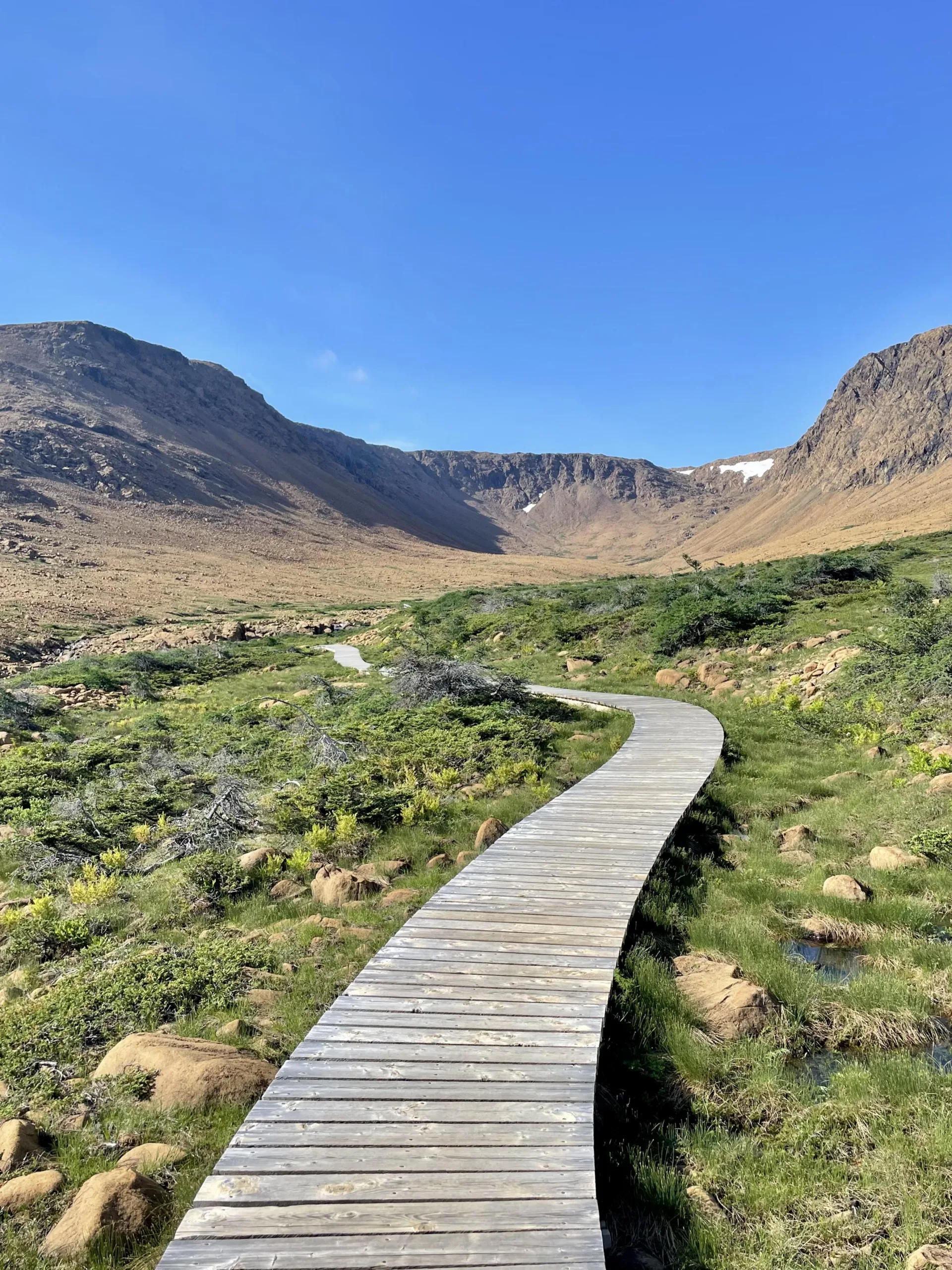
The Tablelands are the reason Gros Morne received UNESCO World Heritage designation. In a geological process that is extraordinarily rare anywhere on Earth, a piece of the planet’s mantle the layer beneath the crust, normally buried kilometres below the surface has been pushed upward by tectonic forces and exposed at the surface. The result is a rust-coloured, barren plateau that looks like another planet set against the green boreal forest of the surrounding park.
The high mineral content of the peridotite rock is toxic to most plant life, creating a striking barren appearance in contrast to the lush vegetation only metres away at the trail’s edge. The Tablelands Trail follows the valley floor alongside the formation for 4 km return, with interpretive panels explaining the geological history at regular intervals. Additionally, a second trail climbs to a lookout above the plateau for a broader perspective on the formation’s scale. Drive 30 minutes south from Rocky Harbour through Norris Point to Woody Point for the trailhead.
⛰️ Gros Morne Mountain The Full-Day Challenge
Gros Morne Mountain holds the second-highest elevation in Newfoundland and Labrador. The trail spans 16 km return and requires a full day to complete most hikers should plan for 7–8 hours. The ascent passes through boreal forest before breaking into open alpine terrain, with the final scramble to the summit plateau offering progressively expanding views across the Long Range Mountains, the Gulf of St. Lawrence, and on clear days, as far as the Quebec coast.
Due to the trail’s difficulty, proper preparation is essential: appropriate waterproof footwear, sufficient water (2–3 litres), food for the full day, warm layers (summit temperatures can be significantly colder than the valley), and a trail map. Additionally, check conditions at the Visitor Centre before setting out the summit is frequently in cloud even when the valley is clear, and the hike is not recommended in wet conditions. Start no later than 8am for summer departures.
🥾 Hiking Trails for Every Ability
With over 100 km of trails ranging from short beach walks to multi-day backcountry traverses, Gros Morne accommodates every fitness level. Here are the key trails grouped by difficulty.
A short, easy loop from Rocky Harbour to the Lobster Cove Head Lighthouse with excellent coastal views over the Gulf of St. Lawrence. Ideal for an evening walk or for travellers with limited time. The lighthouse area often has whale sightings offshore in summer.
A short hike to a picturesque waterfall where water cascades down rocks into a pool below. A good area to stop for a picnic or rest on a hot summer day. Accessible for most fitness levels including families with children.
Along the valley floor of the UNESCO-designated geological wonder. Interpretive panels explain the exposed Earth’s mantle. Relatively flat and accessible. Drives 30 minutes south from Rocky Harbour through Norris Point.
The 3 km walk each way to the Western Brook Pond boat dock through boreal forest and bog terrain. Towering cliffs come into view as the trail approaches the pond. Flat but can be muddy waterproof footwear recommended.
One of the most scenic trails in the park descends through forest to dramatic coastal sea stacks and ocean vistas on the Gulf of St. Lawrence. The green basalt columns contrasting with the sea is one of the most distinctive sights in Gros Morne. Some steep sections on the descent.
Full day see the dedicated section above. The second-highest peak in NL. Suitable for fit, experienced hikers only. Extraordinary summit panorama across Long Range Mountains and Gulf of St. Lawrence. Start early.
The Parks Canada annual pass costs $75/adult or $145/family and covers all national parks and historic sites in Canada. On a 10-day Newfoundland itinerary that includes Gros Morne and Terra Nova, this pass pays for itself within the first two days. Consequently, if your itinerary includes both parks and it should buy the pass at the first Parks Canada entry point and don’t pay daily fees for the rest of the trip.
🏘️ Communities Within the Park
Seven communities exist within or adjacent to Gros Morne’s boundaries. Each has its own character and together they provide the accommodation, dining, and cultural experiences that make an extended park visit comfortable and rewarding.
The largest community and main base for most visitors. Widest range of accommodation, dining, and services. Ocean View Hotel, Ennis House B&B. Lobster Cove Head Lighthouse is a 10-minute drive.
Sitting at the junction of Bonne Bay’s two arms, Norris Point offers stunning water views and a quieter atmosphere than Rocky Harbour. Good selection of B&Bs. Short ferry connects to Woody Point seasonally.
Gateway to the Tablelands hike and Green Gardens trail. The Discovery Centre in Woody Point has the best interpretive exhibits in the park. Home to the annual Writers at Woody Point literary festival.
A 30-minute drive south of Woody Point along the Tablelands valley. Remote, beautiful, and offering some of the freshest seafood in Western Newfoundland from a handful of waterfront restaurants.
Home to the Gros Morne Theatre Festival a celebrated summer theatre event running throughout the park season. Shallow Bay Beach is nearby one of the park’s most accessible and beautiful beaches.
A small, remote community near the northern section of the park. Close to the Baker’s Brook Falls trail and Western Brook Pond area. Limited services.
🦌 Wildlife in Gros Morne
Gros Morne is one of the best places in Newfoundland for wildlife viewing, with several species present in numbers and proximity not typical of more visited parks. The combination of diverse ecosystems coastal lowland, boreal forest, alpine plateau, and tidal inlet supports an unusually rich array of mammals and birds.
| Species | Likelihood | Best Location | Best Season |
|---|---|---|---|
| Moose | Very common | Roadsides throughout park, meadows near pond edges | Year-round most active dawn and dusk |
| Black Bear | Occasional | Forest edges, berry patches, Western Brook Pond cliffs | June–October |
| Bald Eagle | Common | Coastal sections, Western Brook Pond cliffs, Bonne Bay | May–September |
| Arctic Fox | Occasional | Alpine sections of Gros Morne Mountain | Winter–spring |
| Woodland Caribou | Rare backcountry | Long Range Mountain plateau | Year-round (backcountry) |
| Minke / Fin Whale | Occasional offshore | Lobster Cove Head, Green Gardens coast | June–September |
| Seabirds | Common coastal | Coastal trail sections, Lobster Cove Head | May–September |
🏡 Where to Stay Near Gros Morne
Accommodation within and adjacent to the park ranges from national park campgrounds to boutique B&Bs and self-catering cottages. Book 2–3 months ahead for July and August options are limited and fill quickly.
| Property | Location | Type | Notes |
|---|---|---|---|
| Ocean View Hotel | Rocky Harbour | Hotel | Most centrally located property. Ocean views. Book ahead for Jul–Aug. |
| Ennis House B&B | Rocky Harbour | B&B | Well-reviewed B&B with breakfast included. Good local knowledge from hosts. |
| Spruce Grove Cottages | Rocky Harbour | Self-catering cottages | Good for families or longer stays. Kitchen facilities. |
| Middle Brook Cottages & Chalets | Norris Point area | Cottages | Scenic Bonne Bay location. Private and quiet. |
| Shallow Bay Motel & Cabins | Cow Head | Motel/cabins | Near Shallow Bay Beach. Good base for northern park trails. |
| National Park Campgrounds | Multiple locations | Camping | Gros Morne has several excellent campgrounds. Book at reservation.pc.gc.ca. $28–$38/night. |
✈️ Getting to Gros Morne
Gros Morne is in western Newfoundland the farthest point from St. John’s on the island. This is a core reason the 10-day itinerary recommends flying home from Deer Lake rather than driving back across the island.
| Route | Distance | Time |
|---|---|---|
| Deer Lake Airport (YDF) → Rocky Harbour | ~45 km | 30 min |
| St. John’s (YYT) → Rocky Harbour (drive) | ~530 km | ~7 hrs |
| Port aux Basques (Marine Atlantic ferry) → Rocky Harbour | ~170 km | ~2 hrs |
| Twillingate → Rocky Harbour | ~195 km | ~2.5 hrs |
| Corner Brook → Rocky Harbour | ~75 km | ~1 hr |
Deer Lake Regional Airport has Air Canada service from Toronto and Montreal. For travellers doing a one-way cross-island road trip, flying into St. John’s (YYT) and out of Deer Lake (YDF) or vice versa is the most efficient routing. It eliminates a 7-hour return drive across the island and saves a full travel day. Alternatively, the Marine Atlantic ferry from Port aux Basques (2 hrs south of the park) is an excellent and cost-effective option after the 2025 50% fare reduction.
Plan Your Gros Morne Visit
Book your rental car and Western Brook Pond tour early both sell out for peak season. Lock in your car rate now.
Compare Car Rentals →